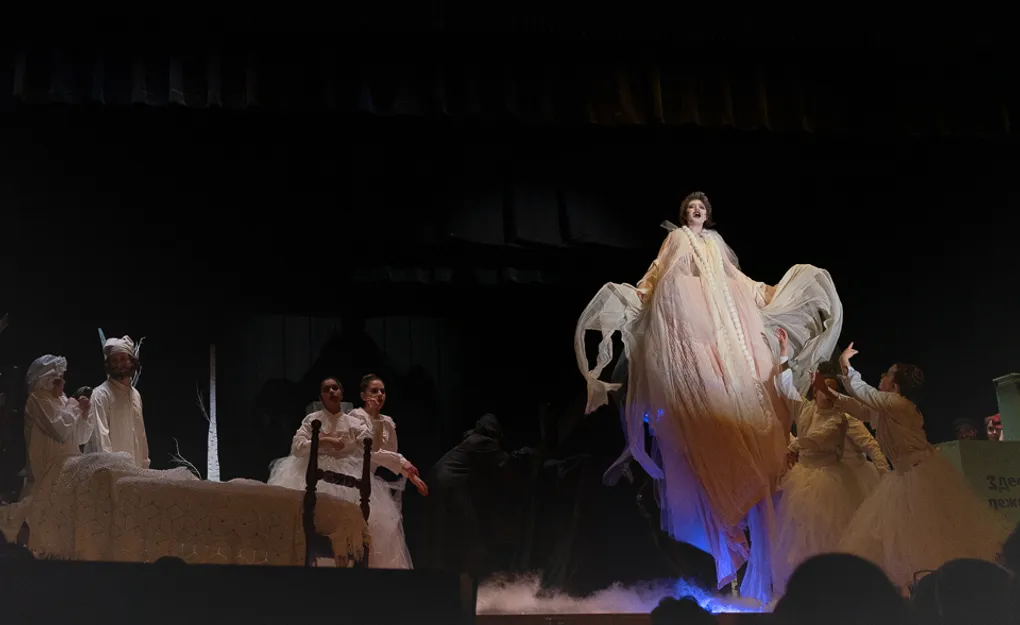
Building Fiddler: How We Made Fruma-Sarah Fly

For our production of Fiddler on the Roof, my role was special projects — the odd, ambitious, one-of-a-kind builds that don’t fit neatly into normal set construction. The biggest of those projects was creating the effect for the ghost of Fruma-Sarah.
The Scene
If you don’t know Fiddler, here’s the setup. Tzeitel, one of Tevye’s daughters, is promised by the matchmaker to Lazar Wolf, the butcher. But Tzeitel is desperately in love with Motel the tailor. She begs her father: “I’ll haul rocks, I’ll dig ditches, just please don’t make me marry him.” Tevye, who loves his daughter, decides to break the match — but he needs a cover story he can sell to his wife.
So Tevye wakes his wife in the middle of the night and claims he has had a dream. As he describes it, the dream comes to life on stage. The ghost of Fruma-Sarah — Lazar Wolf’s deceased first wife — appears to condemn Tzeitel to a terrible fate if she marries Lazar Wolf. It’s Tevye’s invention, his theatrical scheme, but it has to feel real. And because it’s a dream, anything can happen.
That’s the gift of this scene for a set builder: a dream sequence is a free pass. You’re not bound by reality. The question is how far you take it.
The Problem with the Ladder
Most productions handle this simply: put a girl on a tall ladder, give her a big flowing dress, let her loom over Tevye’s bed. It works. It’s clear. But when I put up a ladder on a platform and stepped back to look at it, I felt nothing. It was just so obvious. A girl on a ladder, waving her arms. I knew there had to be something better.
I started thinking about how a ghost would actually move. Not walk. Not climb. A ghost would glide. A ghost would appear from nowhere and come toward you at an unnatural speed. And a ghost wouldn’t stop at the edge of the stage — she would keep coming.
That’s when the concept clicked.
The Concept
Here’s the staging I envisioned:
- The curtain parts at the very back of the stage. Fruma-Sarah appears, spotlit, in her full white gown.
- She doesn’t walk forward — she glides, moving unnaturally fast toward the front of the stage.
- She reaches the edge. The audience expects her to stop. She doesn’t.
- She glides right off the stage, over the front row of the audience.
- Then - arms out - she flys into the air, gown billowing — straight up 15 feet overhead.
- She sings her condemnation from the air, moving, turning, haunting.
- Tevye’s bed is pulled back to center stage. Fruma-Sarah descends and looms over him for her final proclamation.
- She dissolves back into the darkness.
To pull this off, Fruma-Sarah needed to do two things: roll smoothly across the stage at speed, and then be lifted into the air on cue. The rig I built had to do both.
The Rig: Inspired by SNL Camera Operators
The inspiration came from watching Saturday Night Live. They have a camera operator in a chair - on an arm that moves smoothly to catch the action. The chair is attached to a platform on wheels, and can move around freely. That combination of smooth rolling motion and height variation was exactly what I needed.
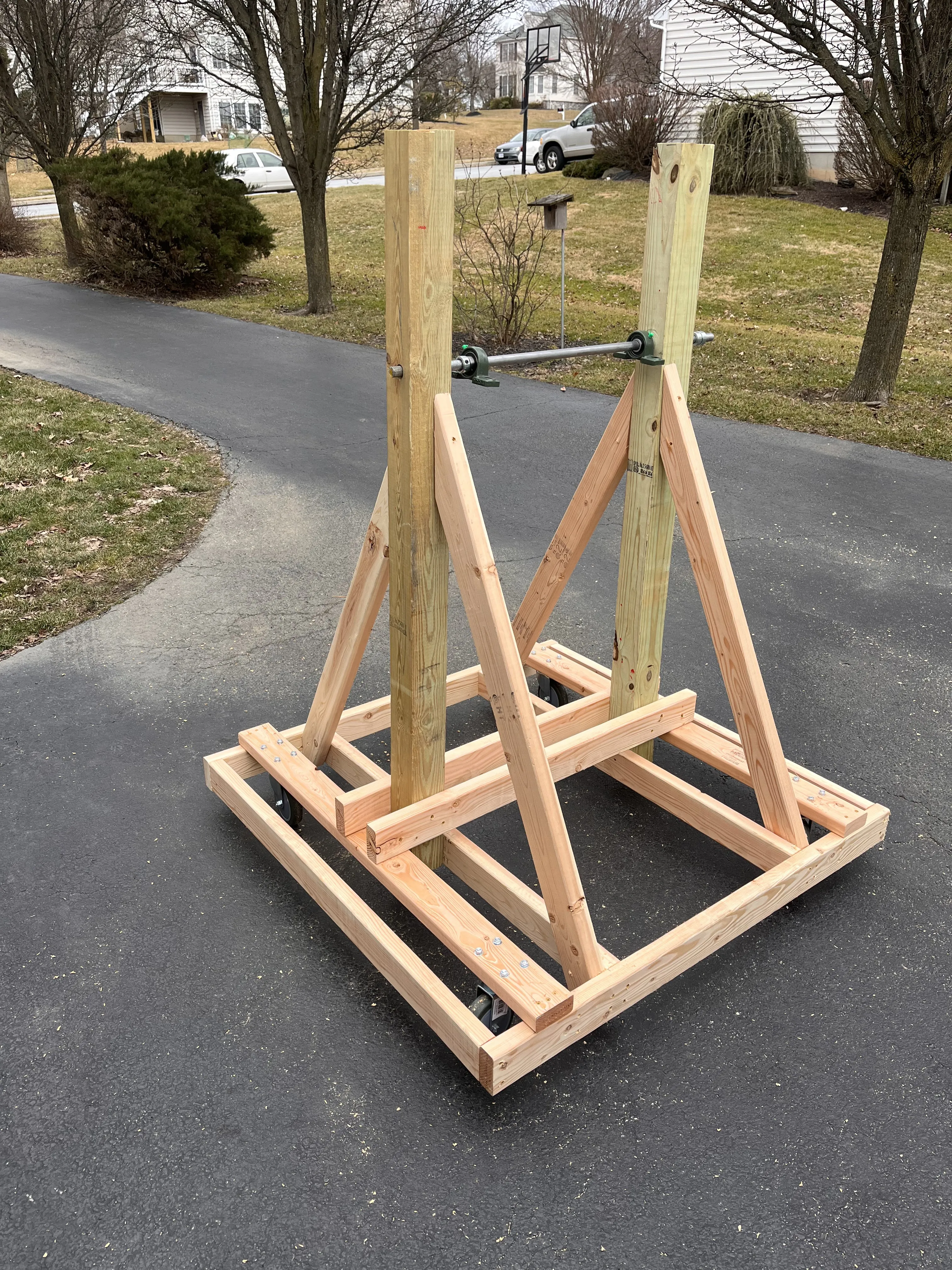
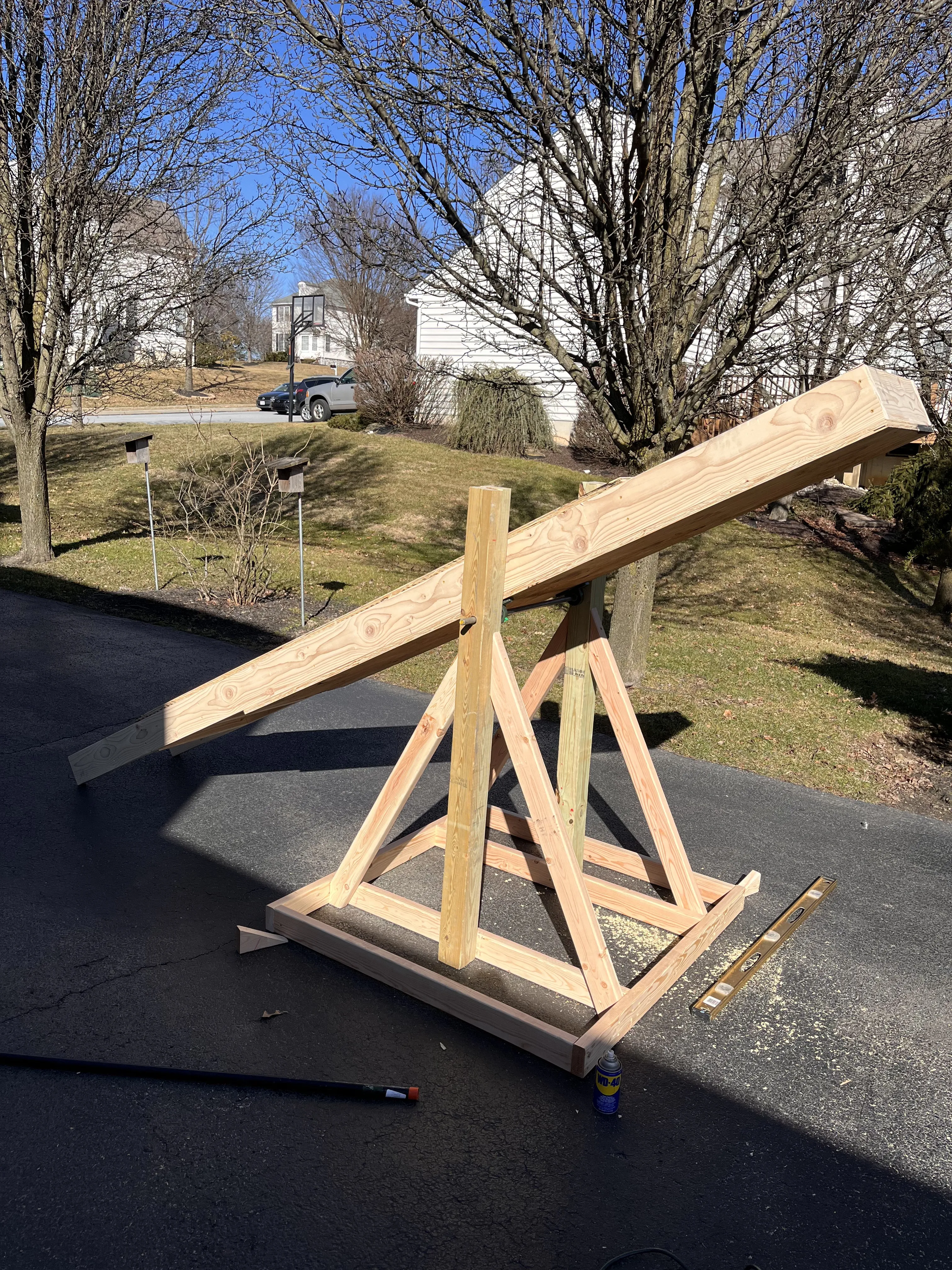
I built a custom rig in three parts: a rolling base, an A-frame fulcrum tower, and a counterweighted seesaw arm.
The Rolling Base
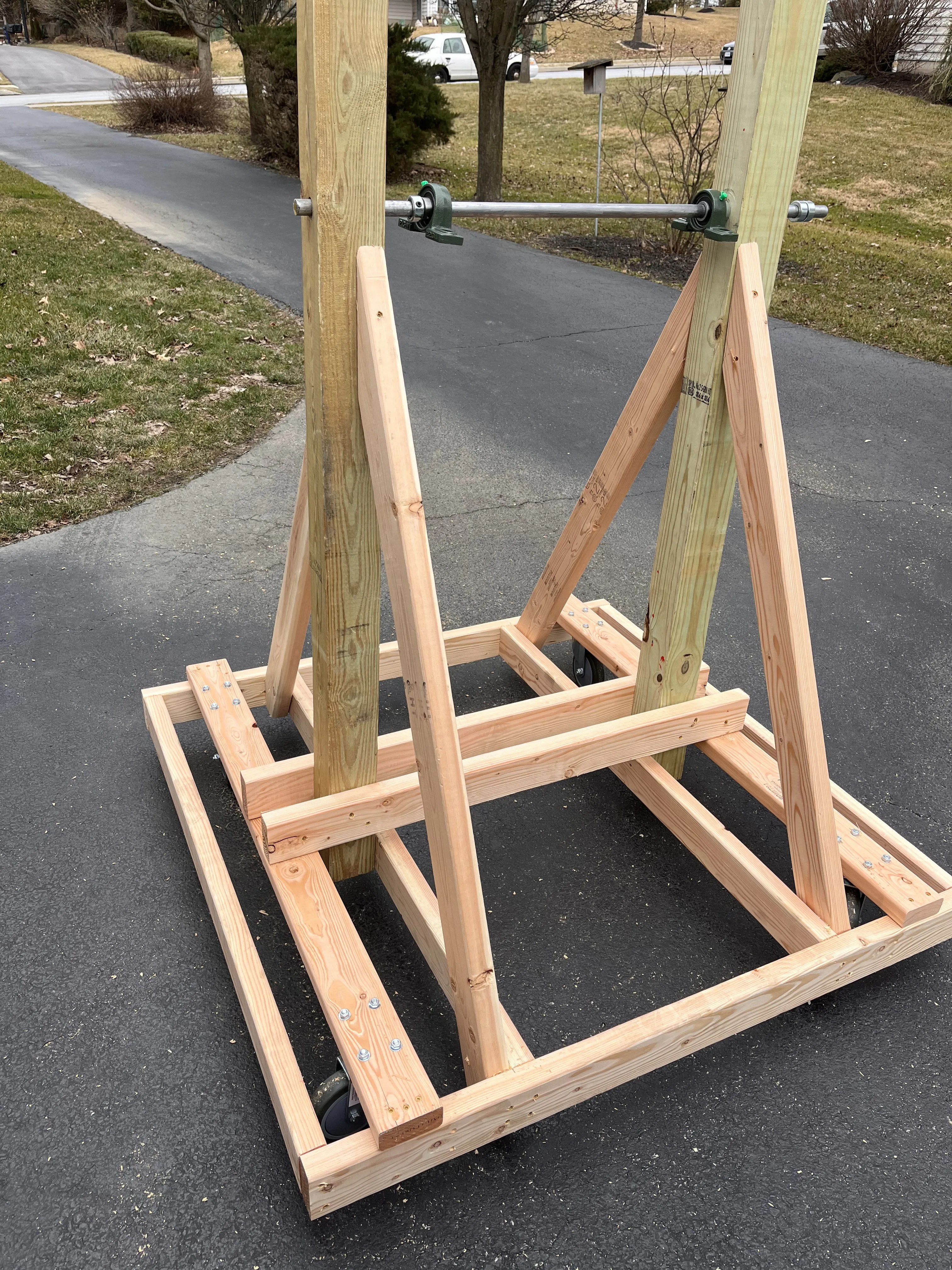
The foundation is a sturdy 2x4 frame, backed with plywood for rigidity. Five-inch high-quality swivel casters are mounted at the corners — quality matters here because you need smooth, quiet rolling on a stage floor. Cheap casters wobble, squeak, and drag.
The A-Frame Fulcrum Tower
On top of the base, I built an A-frame out of 4x4 posts with diagonal bracing. This is the pivot point for the seesaw arm. The key hardware here is a pair of pillow block bearings — also called race bearings — which are industrial-grade bearing housings that bolt to the wood and provide a smooth, zero-friction pivot point for the arm axle.
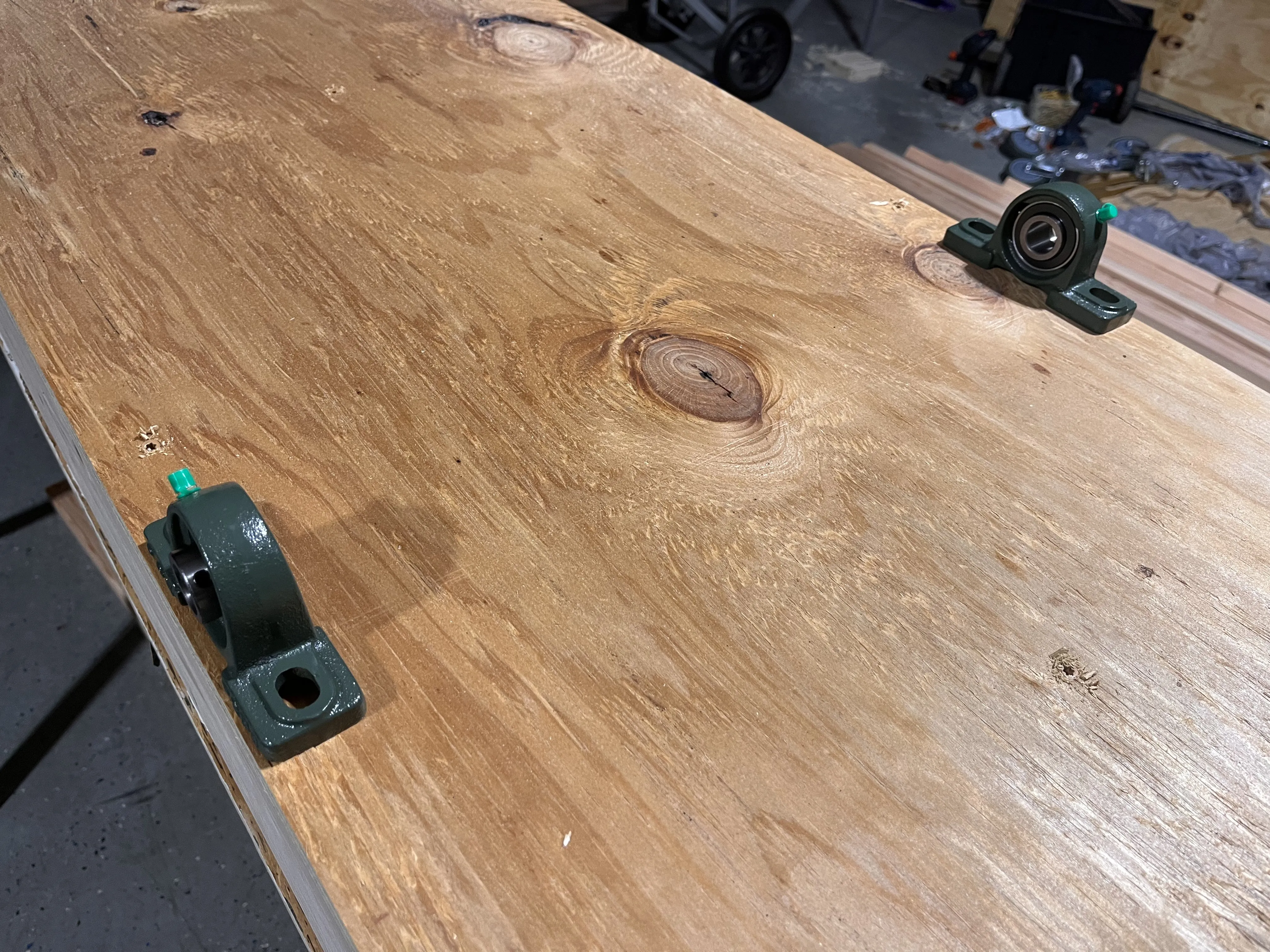
Don’t cheap out on the bearings. This is a person going into the air. The bearings need to be rated well above the load you’re putting on them.
The Seesaw Arm
The arm itself is the heart of the rig. I used 2x10 lumber for the main beam, laminated top and bottom with plywood. This creates what is essentially a wooden I-beam — extremely strong and resistant to flex. The axle runs through the pillow block bearings at the fulcrum point. I was careful not to make any holes in the main beams - since I needed the to be super strong.
A secondary stabilizer arm extends from the passenger end to keep the actress from tipping forward or backward as the arm rises. Think of it like the safety bar on a carnival ride — it keeps her parallel to the stage no matter what angle the arm is at.
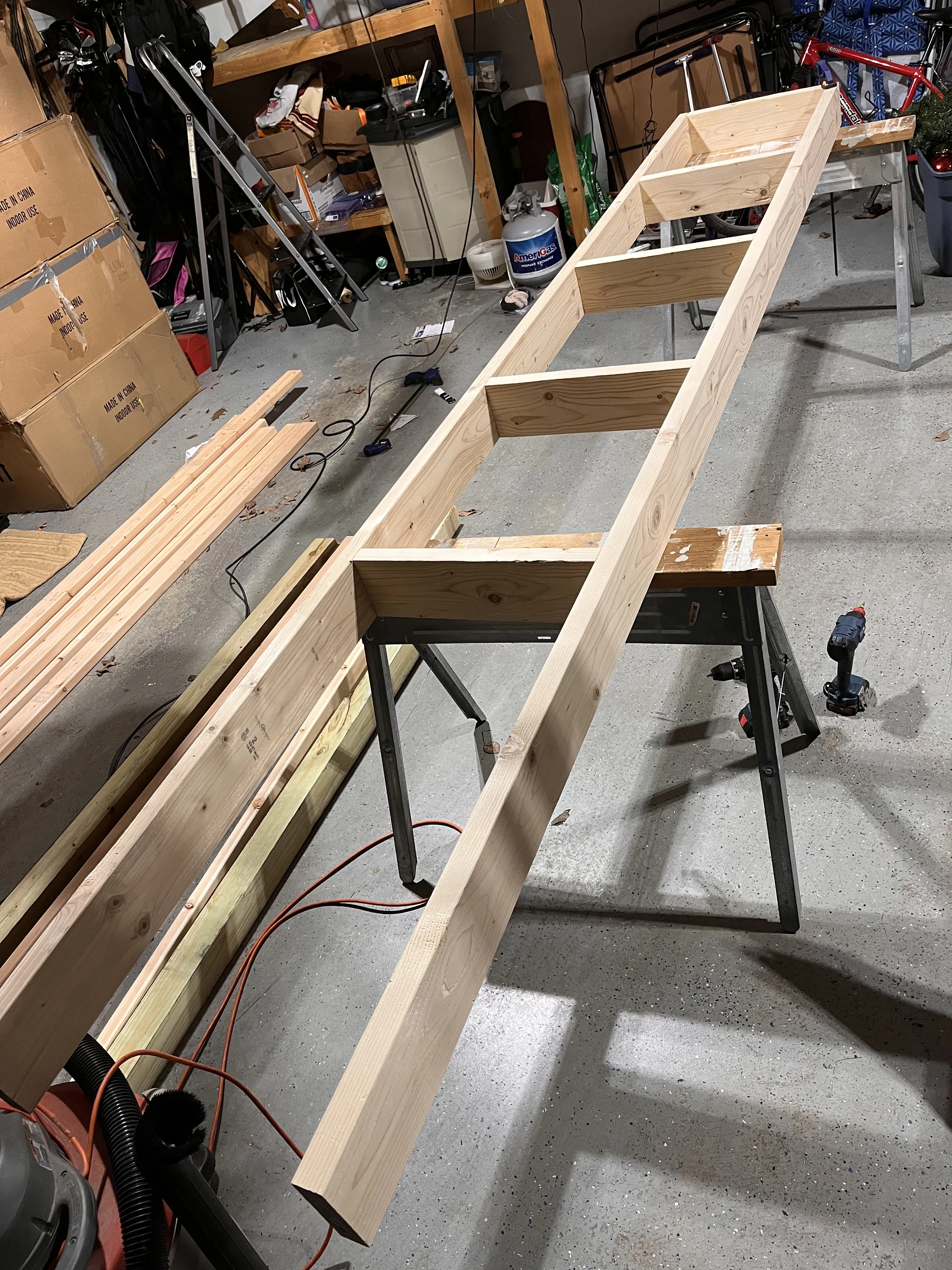
The full rig assembled on my driveway for testing:
Testing It
I tested the rig on my driveway with my kids as the first brave volunteers. Three people man the rig in performance: myself and two others on the counterweight side of the arm. When we push down, the actress goes up. The motion is smooth and controlled — not a jerky lift, but a steady, ghostly rise.
I’ll be honest: I was haunted by this thing in the weeks leading up to the show. I kept running through every way it could fail. But the engineering held. Not a single problem in performance.
The Actress
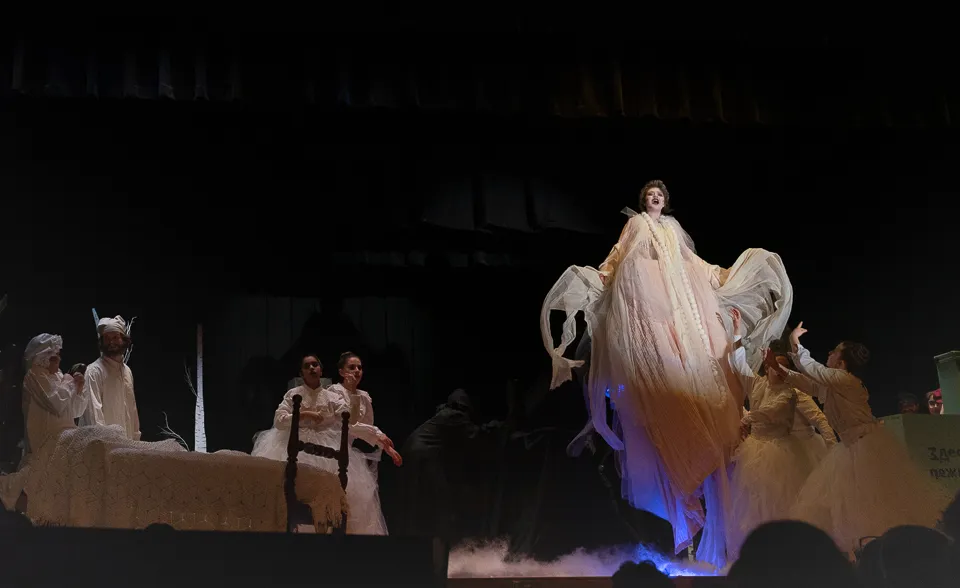
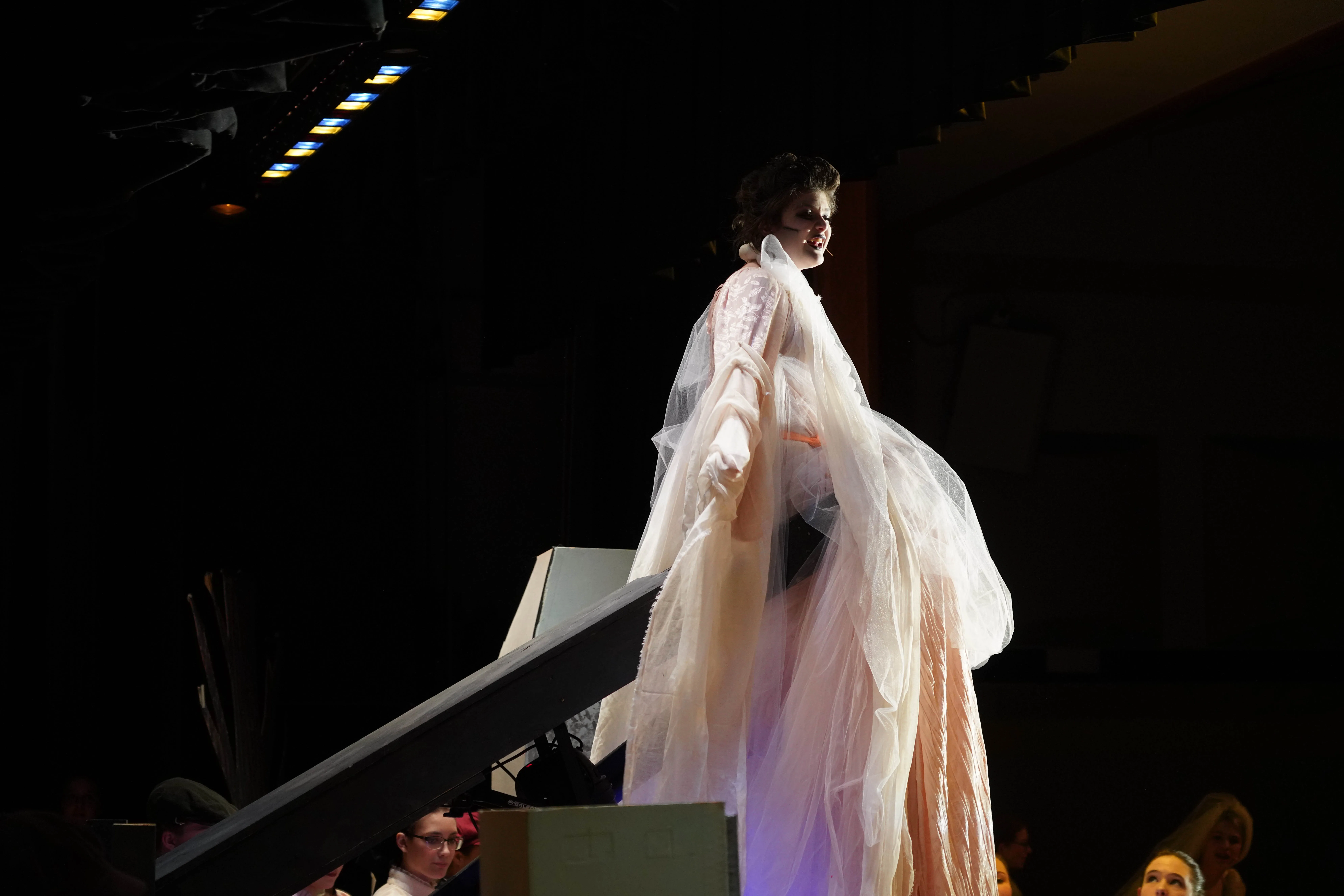
None of this works without the right person in the air. The actress who played Fruma-Sarah was fearless. Absolutely fearless. She committed completely — the gown billowing, arms raised, singing full voice while suspended 15 feet in the air over the audience. Her performance was the reason the effect landed.
When she rolled off the edge of the stage and over the front row, the audience gasped. You can actually hear it — listen closely at the moment she rises into the air.
The Performance
Here’s the full scene in action. Fruma-Sarah elevated in the air, the ghost ensemble in white surrounding Tevye’s bed, fog rolling across the stage floor:
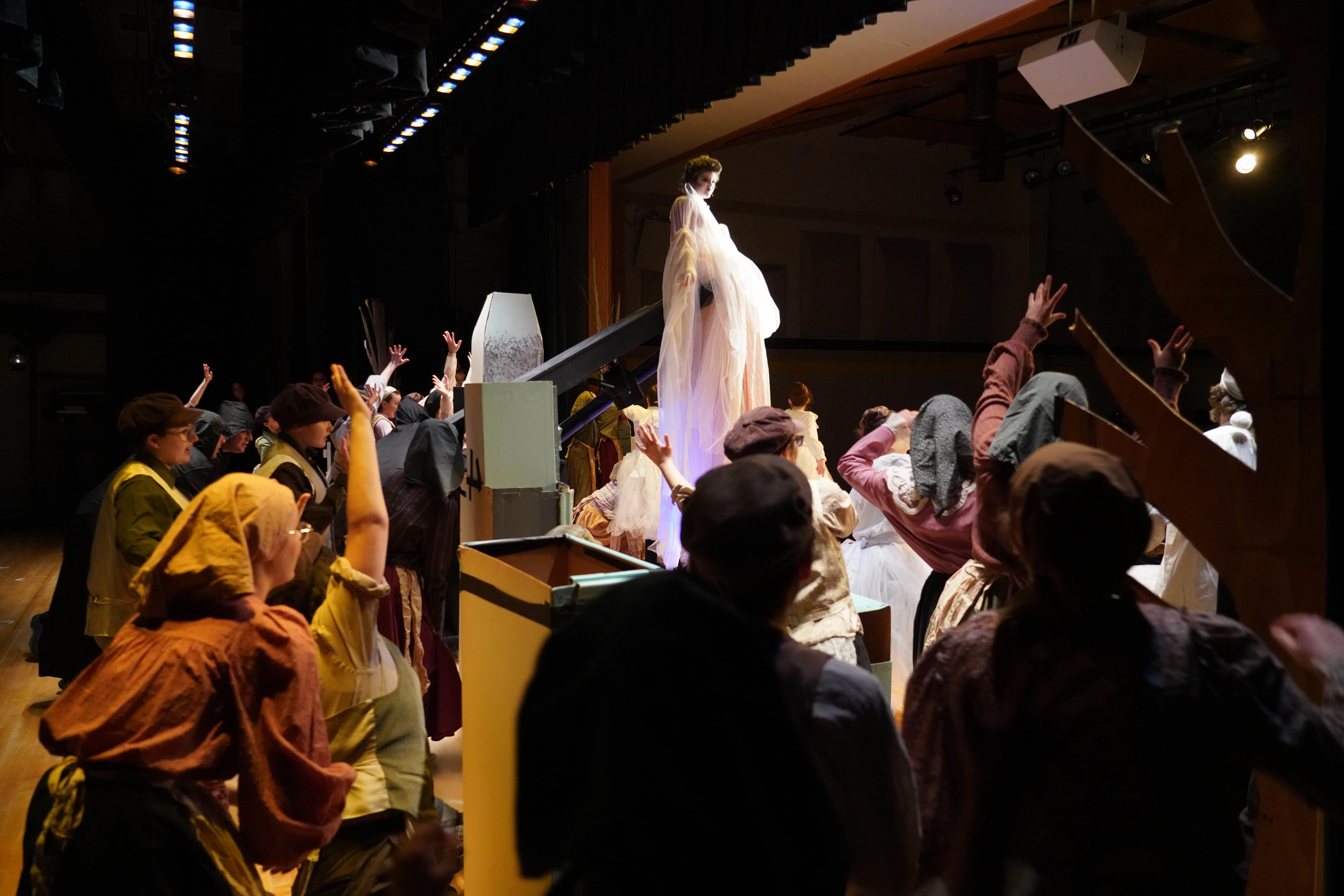
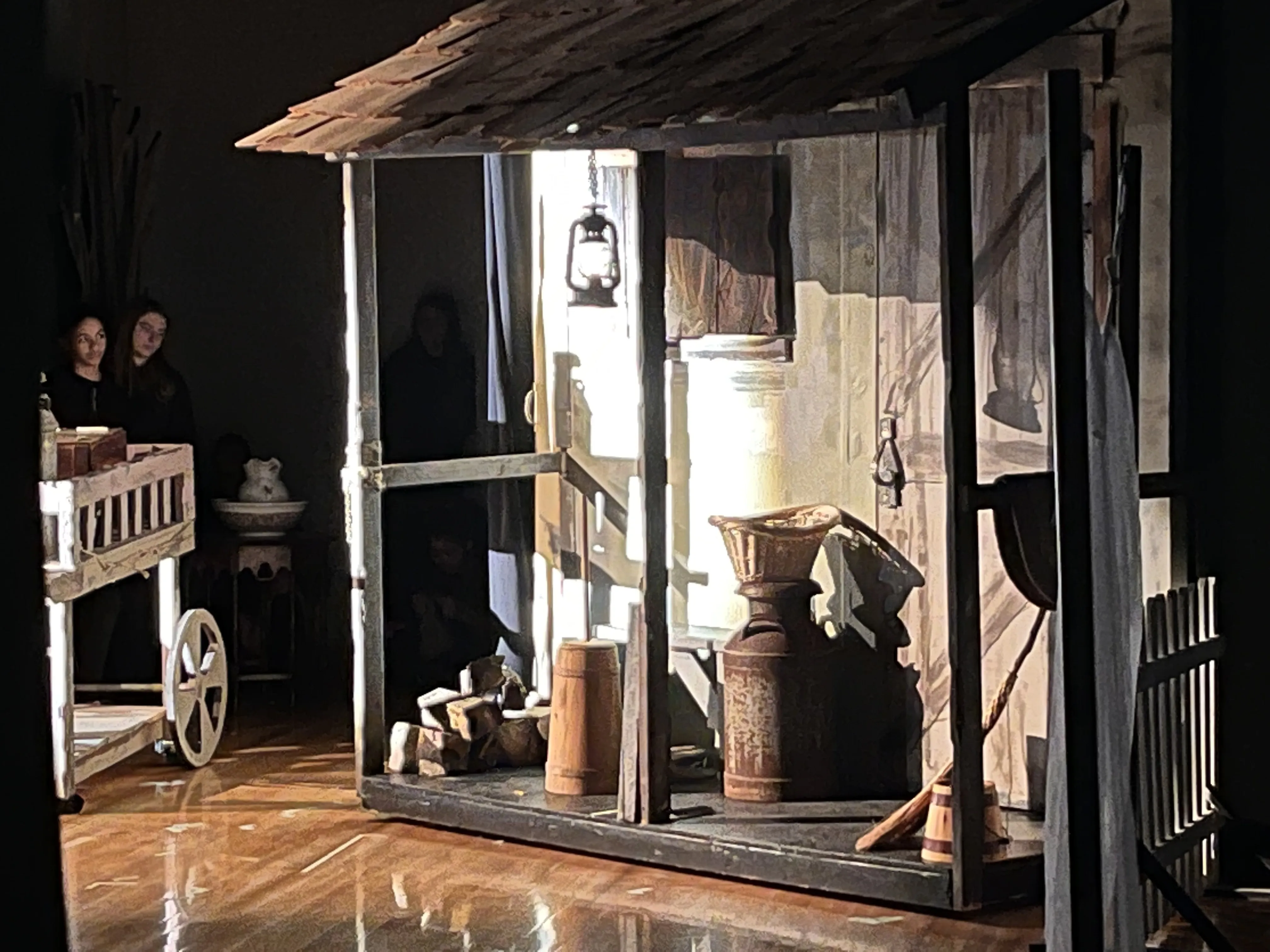
The rest of the Fiddler set was equally beautiful. The main set constructor built Tevye’s house as a full three-dimensional structure — wood plank siding, a working lantern, milk cans and firewood for dressing. It had real weight and texture to it.
Tips If You’re Building This Effect
- A ladder is fine - this was crazy. However, it reads immediately as a ladder. A ladder on wheels is better then a static ladder.
- Use pillow block bearings for the fulcrum. They’re cheap, strong, and provide silky smooth rotation. Search “pillow block bearing” or “UCP bearing” online.
- Build the arm as an I-beam sandwich. 2x10 lumber laminated top and bottom with plywood gives you a beam that won’t flex under load. I actually filmed the beam under load, and it basically didn’t flex. Crazy strong.
- Use quality casters. 5-inch swivel casters rated for the combined weight of the actress, the arm, and dynamic load. Smooth movement was critical - so factor in the height of the wheels.
- Cast someone fearless. The engineering is only half the equation. The performance makes the effect. Find an actress who can commit fully while hanging in the air. Our actress was amazing. This was a wild ride - and she killed it.
The Fruma-Sarah dream sequence is the craziest effect I have ever created. Super cool, glad it all worked and an amazing effect for the show.