You Can't Lead What You Haven't Built

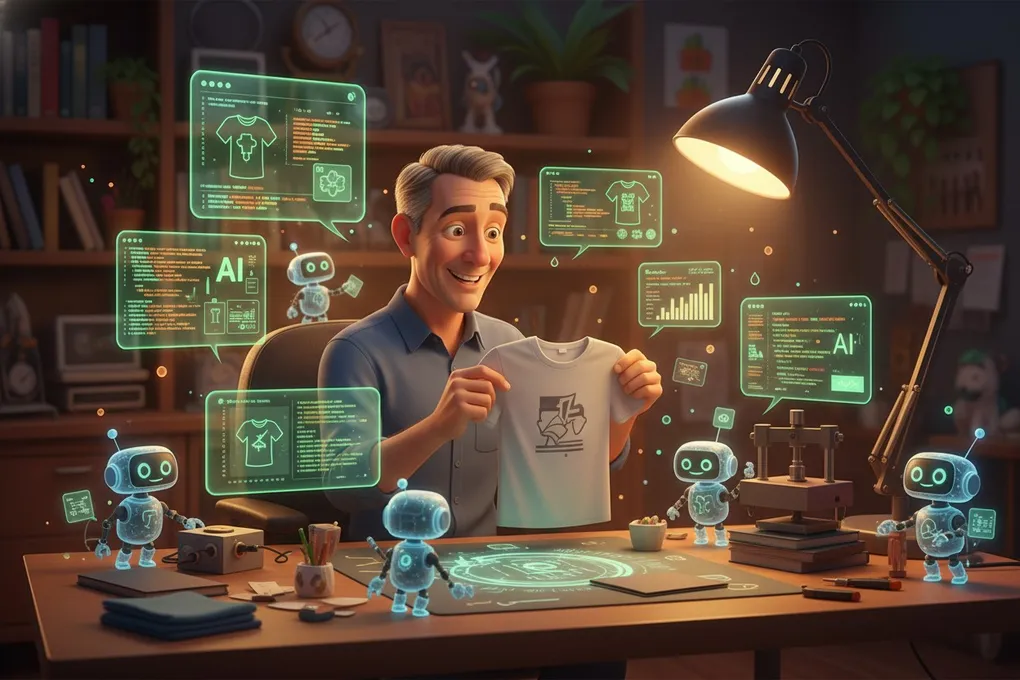
By day, I lead agent product management at Pfizer. By night, I run a t-shirt company staffed almost entirely by AI agents.
I’m not joking, and it’s not a bit. It’s called Meatware Labs, and its tagline is “Merch for carbon-based systems running unstable software.” It sells nerdy apparel about the AI era to the people living through it — engineers, researchers, builders, the terminal-window philosophers. And almost every function of the business — watching trends, generating concepts, writing listings, prepping artwork, tracking the money — is run by a crew of AI agents.
Almost every function. Not all of them. That gap is the entire point, and it’s what this series is going to be about.
A company with one human in it
Here’s the org chart. My Chief of Staff is named Pam Beesly. My CTO is Dwight Schrute. My controller is Oscar Martinez. Around them sits a department crew: a Trend Radar that watches AI culture, a Creative Director that turns what it sees into shirt concepts, a Compliance agent that catches IP and taste risk before it becomes a lawsuit, Art Production, Merchandising, Vendor Ops, Growth, Customer Experience. Every day they run a “drop” — scan the day’s AI noise, pitch concepts, refine the winners, prep them for production.
And then they stop and wait for me.
Because Meatware Labs is agentic, not autonomous — a distinction I now believe is the whole ballgame. The agents draft, scan, coordinate, track, and prepare. The human owns taste, spend, legal risk, and anything that goes public. I’m not the CEO in the corner-office sense. I’m the meatcomputer: the carbon-based decision-maker in the loop. Editor-in-chief. Final approver. Risk owner. Capital allocator. Taste filter. The one whose name is on it when it ships.
Nobody gets replaced by AI here. The founder just becomes a very specific kind of bottleneck — the kind you actually want to keep.
Why a t-shirt store, of all things
People assume that if you want to learn agentic systems, you build something serious. A research repo. A SaaS demo. Something that looks like work.
I went the other way on purpose, and the reason is the most useful design decision I’ve made: low stakes, real stakes.
A merch store is a real business. There’s real money moving, real customers with real expectations, real questions of taste, real IP and trademark landmines, and a real daily cadence that doesn’t care whether I’m tired. You cannot fake your way through it. A toy demo lets you fool yourself — you can declare victory because the prompt returned something that looked plausible. A store that takes payment and prints a physical object that arrives at a stranger’s house cannot be faked. The market is the grader, and it grades in public.
But — and this is the part that makes it the right rig — the blast radius is tiny. If a drop flops, if an agent writes a cringe-worthy product description, if a concept misses, nobody’s clinical trial is affected. No patient is waiting on the other end. No regulator is reading the output line by line. The cost of being wrong is a bad t-shirt and a lesson.
That combination — real enough to teach you something true, small enough that the lesson is cheap — does not exist in my day job. It can’t. So I built it.
The actual reason I’m doing this
I could give you the LinkedIn version, but here’s the real one.
You cannot lead what you haven’t built.
I sit in rooms where we make consequential decisions about agentic AI at enterprise scale. And I noticed that the felt sense of how these systems actually behave — where they’re genuinely capable, where they quietly fall on their face, what it takes to trust one with something irreversible — does not come from a roadmap, a vendor demo, or a beautifully rendered slide. It comes from watching an agent confidently do the wrong thing at 11pm and having to figure out why. It comes from the unglamorous middle: the coordination, the gates, the moment you realize your “autonomous” system needs a human to catch the one decision that would have cost you.
Demos are designed to make agents look ready. Production is where you find out what “ready” actually means. I wanted to live in the second place, with my own hands on it, with my own money mildly at risk, before I bring strong opinions back to a company where the stakes are measured in human health.
Meatware Labs is my flight simulator. The crashes are cheap. The instincts are real.
What I’ve already learned (a preview)
A few things have already changed how I think, and the series will go deep on each:
- Autonomy is earned, not granted. You don’t hand an agent more authority because it’s smart. You hand it more authority once it can show you what it saw, what it chose, what it rejected, and why — and once you can replay that. Memory and observability come before trust, not after.
- Gate the irreversible. Drafting a concept? Let the agents run. Publishing a product, spending ad money, making a customer promise, touching anything legal or financial? That stays behind a deterministic gate with a human on the far side. Automation should create leverage, not abdication.
- Taste is still a human bottleneck — and that’s a feature. The agents can generate a hundred concepts before I finish my coffee. They cannot tell me which one is funny, which one a real person would wear in public, which one is one trademark notice away from a bad day. That judgment hasn’t moved. If anything, it’s the only thing that’s gotten more valuable.
None of this is the “AI runs everything now” story you’ve been sold. It’s quieter and more honest: a small, human-led, agentic company trying to move faster than a traditional startup without losing taste, judgment, or accountability. That’s the experiment. I genuinely don’t know yet if it works.
What this series is
I’m going to build this in public. Not carelessly in public — you won’t see API keys, customer data, or half-baked legal conclusions. But you’ll see the backstage: the agent crew and how it’s wired, the daily-drop machine, the architecture decisions, the economics, and the failures. Especially the failures, because that’s where the actual lessons live and most “building in public” conveniently skips them.
If you lead AI anywhere — or you’re trying to figure out what’s real underneath the hype — I think the view from inside a tiny agentic company is more useful than another think-piece. It certainly has been for me.
So: welcome to Meatware Labs. The agents are doing the work. I’m just the meatcomputer in the loop, deciding what’s actually good enough to ship.
More soon — the crew has a drop to run, and I have a shirt to approve.